
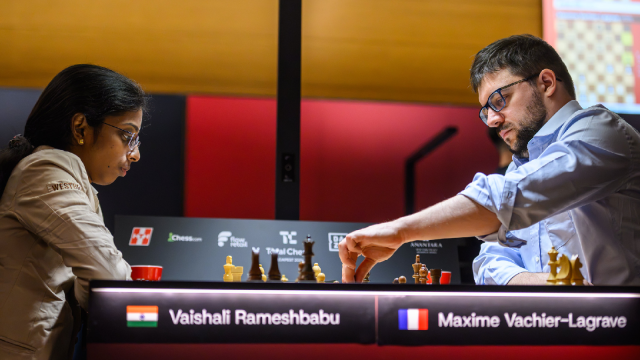
The world of professional chess is experimenting with a new competitive format, and India's R Vaishali Rameshbabu has experienced its challenges firsthand. At the Total Chess World Championship Tour pilot tournament in Budapest, Hungary, Vaishali suffered a defeat against French Grandmaster Maxime Vachier-Lagrave during the opening round of the Fast Classic section. The result highlighted how significantly a shorter time control can influence decision-making, even among experienced international players.
The tournament has introduced an unusual version of classical chess in which each competitor receives 45 minutes for the entire game, along with an additional 30 seconds after every move. Traditional classical tournaments generally provide players with considerably more time, often beginning with 90 or 120 minutes. By reducing the available thinking time, the organisers are attempting to create a format that retains the strategic depth of classical chess while making matches more dynamic for spectators.
Vaishali's encounter with Vachier-Lagrave demonstrated the difficulties associated with this experiment. The French grandmaster entered the game with a rating advantage of approximately 255 points over the Indian player. Although the matchup was already challenging on paper, the clock became an equally important opponent as the game progressed.
The decisive moment arrived on the 34th move. Under considerable time pressure, Vaishali played King to e3, whereas the stronger continuation identified by chess engines was the pawn move b4. The mistake significantly damaged her position and contributed to her eventual defeat. The clock situation explains the pressure she was facing even more clearly. By the 23rd move, Vaishali had less than a minute remaining, while Vachier-Lagrave still had almost nine minutes available.
The incident illustrates an important distinction between traditional classical chess and the newly introduced format. In longer games, players have opportunities to examine complicated positions, calculate several variations and recover from difficult moments. With only 45 minutes available, competitors must balance strategic accuracy with practical speed. A single extended calculation can leave a player dangerously short of time later in the game.
The opening round also produced mixed results for the other Indian participants. R Praggnanandhaa drew his encounter against German Grandmaster Vincent Keymer, while Arjun Erigaisi secured a draw against American Grandmaster Hans Niemann. Their results demonstrated that adapting to the new time control will be a challenge across the tournament's elite field.
Interestingly, Vaishali had already produced an impressive performance in the preceding blitz competition, defeating Hans Niemann and four-time US champion Wesley So. She finished the nine-round blitz event with four points, showing that her difficulties in the faster classical game should not be interpreted as a reflection of her overall competitive ability.
The Budapest tournament features 24 leading players and combines blitz, rapid and Fast Classic chess. The pilot event carries a prize fund of $650,000 and is intended to test a broader championship model that rewards versatility across different time controls.
For Vaishali, the tournament also provides valuable preparation ahead of her upcoming Women's World Championship challenge. The experience of managing time pressure against elite opposition could prove useful as she continues to develop her competitive approach. More broadly, the Budapest experiment will offer organisers an opportunity to evaluate whether faster classical chess can attract wider audiences without sacrificing the intellectual character that defines the sport.