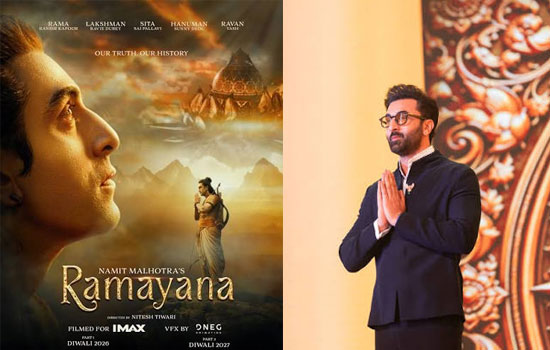
A brief remark at a public event has placed Ranbir Kapoor under intense social media scrutiny, prompting the actor to apologise following a speech about the Indian epic Ramayana. The controversy emerged after his comments at a Kolkata event went viral, with viewers questioning whether his wording accurately conveyed the timeless message associated with the story of Rama and the triumph of righteousness.
During the event, Ranbir reportedly said, “Burai kitni bhi ho, aakhir mein anth sachai aur achhai ki hi hogi.” The statement attracted criticism from people who felt that the intended message should have been expressed more clearly as the ultimate victory of goodness over evil. The actor’s subsequent apology has brought renewed attention to both the incident and the sensitivity surrounding public discussions of culturally significant stories.
The Ramayana occupies a distinctive place in Indian cultural life, extending beyond literature and religion into theatre, television, cinema, festivals and everyday expressions of moral values. Its central conflict between Rama and Ravana is frequently interpreted through the struggle between righteousness and wrongdoing. As a result, even an unintentional verbal mistake while discussing the epic can attract a response far greater than an ordinary speech-related error.
For a celebrity addressing a large audience, the context in which a statement is delivered matters almost as much as the words themselves. Live speeches can involve spontaneous phrasing, nervousness and the challenge of communicating complex ideas in a few sentences. A slip of the tongue does not necessarily establish what a speaker believes, but when the subject carries religious or cultural significance, audiences may pay closer attention to the precise wording.
Social media has further changed the way such moments develop into public controversies. Short video clips can travel rapidly, often reaching viewers without the full context of the original event. Some users may interpret a remark as an innocent verbal error, while others may view it as a failure to communicate an important cultural message. This difference in interpretation can turn a brief moment into a wider debate about accountability, public communication and respect for tradition.
Ranbir’s apology is therefore an important part of the episode. Acknowledging a mistake can help address concerns and clarify that the intention behind a statement may differ from how it was received. At the same time, the effectiveness of an apology often depends on whether audiences believe it responds directly to the issue that caused the criticism. The available details do not establish every aspect of the exchange, so conclusions about the actor’s intentions should be approached carefully.
The incident also highlights the responsibilities that accompany high-profile film projects based on culturally influential narratives. Actors involved in such productions are often expected to engage thoughtfully with the themes they represent, particularly when speaking at promotional events. That expectation does not eliminate the possibility of ordinary human mistakes, but it makes clarity and preparation especially valuable.
For the film industry, the episode is a reminder that promotional appearances can influence public conversation beyond a movie’s casting, visuals or release plans. A single sentence can overshadow a larger event when it touches on a subject that audiences consider deeply meaningful.
With Ranbir Kapoor having apologised, attention may now shift from the wording of the original remark to how the controversy settles. The episode ultimately demonstrates how closely public figures are watched when discussing cultural epics—and why careful language matters when communicating their enduring themes to a diverse audience.