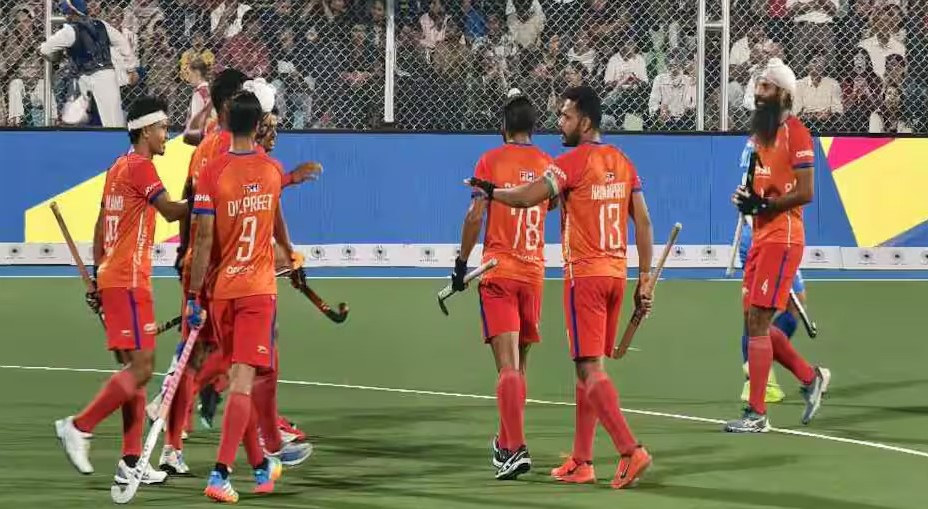
India delivered a commanding performance against South Korea in the Asian Champions Trophy, producing an emphatic 8–0 victory that underlined the team’s attacking strength. Yet the result has not ended the contest between the two sides. They are scheduled to meet again in the semifinal, where the stakes will be considerably higher and South Korea will have an opportunity to respond.
An eight-goal margin is significant in international hockey, particularly against an opponent with experience at the continental level. Such a result reflects more than the ability to convert scoring opportunities. It can also point to sustained attacking pressure, effective movement around the opposition circle and the capacity to turn possession into meaningful chances. For India, the performance offers a strong confidence boost ahead of the knockout encounter.
The most important aspect of a result like this is the way it can shape the next meeting. India will enter the semifinal with evidence that its attacking approach can trouble South Korea. However, repeating the same performance will require discipline, because the opposition is unlikely to approach the rematch without making adjustments.
South Korea’s immediate challenge will be to identify where the earlier contest became difficult to control. Against an aggressive attacking side, defensive organisation can come under pressure when midfield possession is lost or when players are unable to close down passing options quickly. Improving communication between defenders and midfielders, protecting the central areas and reducing turnovers could become priorities in the next match.
India, meanwhile, will need to avoid allowing the margin of victory to create complacency. A team that has scored eight goals in one meeting may be tempted to expect similar openings in the next, but knockout hockey often follows a different pattern. Opponents tend to defend more cautiously, manage their risks and look for opportunities to exploit spaces left by an attacking team.
The semifinal will therefore test India's ability to adapt rather than simply reproduce its earlier scoring display. Maintaining pressure is important, but so is choosing the right moments to accelerate, controlling possession under pressure and remaining organised when attacks break down. Converting penalty corners and making the most of circle entries can also influence the outcome of a closely contested match.
For South Korea, the rematch presents both a difficult task and a chance to demonstrate a response. The team must move beyond the psychological impact of the heavy defeat and approach the knockout game as a separate contest. A stronger defensive structure and greater efficiency in transition could help change the balance, although the scale of the previous result makes the challenge clear.
For Indian hockey, performances of this kind reinforce the value of combining attacking ambition with tactical control. A major scoreline can attract attention, but tournament success depends on consistency across different opponents and match situations. The semifinal will provide a more decisive measure of how effectively India can carry its current momentum into a pressure-filled encounter.
The 8–0 result has given India a clear psychological advantage, but the next meeting will demand a fresh performance. With a place in the final at stake, the rematch is likely to be a more demanding test of composure, preparation and execution for both teams.